Indians have lived in what is now called Virginia for thousands of years. We are still learning about these people, but Virginia history clearly did not begin in 1607. If you ask any Virginia Indian, "When did you come to this land?," he or she will tell you, "We have always been here."
Recent archaeological digs in Virginia have provided compelling evidence that humans inhabited Virginia at least 18,000 years ago, thousands of years before previously thought
Starting in the 1640s, colonists forced tribal members off the land and transformed it into plantations, forcing them to move onto “reservations.” The Pamunkey Indian Reservation was established in 1646 and may be the oldest reservation in North America.
Native American peoples, including Virginia Indian tribes, were not considered American citizens even after ratification of the Fourteenth Amendment. They often faced discrimination and were denied the equal protection of the laws.
State recognition is the formal declaration of recognition by the Commonwealth of an American Indian tribe. Throughout the month of November, different state-recognized tribes of Virginia will be featured. Learn more!
The Patawomeck Tribe
The Patawomeck tribe of Virginia Indians is based in Stafford County, Virginia, along the Potomac River (Patawomeck is another spelling of Potomac). It is one of Virginia's 11 recognized Native American tribes. The Patawomeck tribe achieved state recognition in February 2010, aided by anthropology research conducted by the College of William and Mary. Today the tribe numbers approximately 2300 members.
They are now undertaking to revive their historic Algonquian language. In the 17th century, at the time of early English colonization, the tribe was a component of the Powhatan Confederacy. At times it was allied with others in the confederacy, and at others, the Patawomeck allied with the English.
Cheroenhaka (Nottoway)
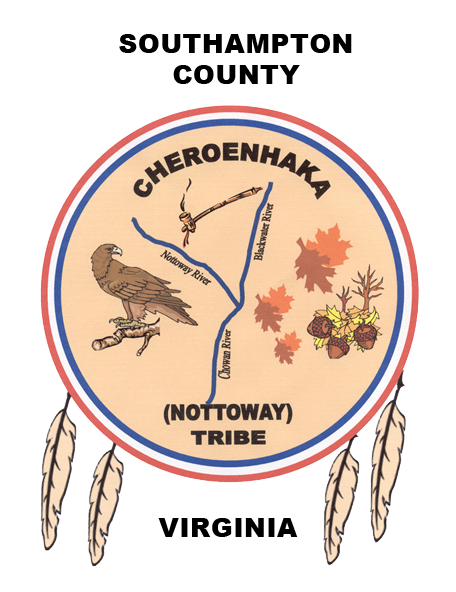
The Cheroenhaka (Nottoway) Indian Tribe made first “ethnohistoric” contact with the English (Colonials) in 1608-09. “WE” were referred to as Mangoak, or Mengwe, by the Algonquian Tribes and later in 1650, per the dairy entries of James Edward Bland, referred to again by the Algonquian Tribes as “Na-da-wa” which reverted to” Nottoway” by the Colonials, and thus our derogatory name ”Nottoway” enters the annuals of Colonial History. In our native tongue, many words as recorded by Professor John Wood of W&M College in 1820, “WE” call ourselves Cheroenhaka (CHE-RO-EN-HA-KA and or Che-ro-ha-kah) – People At The Fork Of The Stream. WE lodged and hunted in the southeastern part of Virginia along the Nottoway and Blackwater Rivers as far as the Albemarle Sound.
The Eastern Chickahominy share an early history with the Chickahominy Indians, who, despite their similar language and culture, lived independently of the Algonquian-speaking Indians of Tsenacomoco. In 1614, following the First Anglo-Powhatan War (1609-1614), they become tributary allies of the Virginia colonists, and in 1646, following the Third Anglo-Powhatan War (1644-1646), joined other Virginia Indians living in the Pamunkey Neck area of present-day King William County. By 1820, families with present-day Chickahominy surnames had begun to settle in Charles City County. In 1870, a state census reported a group of Indians living in New Kent County; these are likely the ancestors of the present-day Eastern Chickahominy Indians.
The Mattaponi Tribe
The Mattaponi Tribe are the “people of the river. We have been in this region for over 15,000 years. The Mattaponi are one of the 6 original tribes of the Powhatan Confederacy. The Mattaponi Indian Reservation was confirmed to the Mattaponi Indians in 1658 by an act of the Colonial Government. The Mattaponi River will always remain the lifeblood of our tribe and an important part of our culture.
Members of the Tribe reside on the same Reservation Lands confirmed to the Mattaponi in 1658, however the land base is much smaller than the original tract set aside for the Tribe. Currently the Reservation measures about 150 acres including wetlands. The Reservation is located in King William County, VA.
Contemporary Mattaponi tribal life is still based deeply in the traditions of our ancestors, such as being faithful to our treaties and living in harmony with the natural world, while at the same time we have adapted to an ever-changing society.
The Nansemond Tribe
We, the Nansemond, are the indigenous people of the Nansemond River, a 20-mile long tributary of the James River in Virginia. Our tribe was part of the Tsenacomoco (or Powhatan paramount chiefdom) which was a coalition of approximately 30 Algonquian Indian tribes distributed throughout the northern, southern, and western lands surrounding the Chesapeake Bay.
Our people lived in settlements on both sides of the Nansemond River where we fished (with the name “Nansemond” meaning “fishing point“), harvested oysters, hunted, and farmed in fertile soil.
When the English arrived in Powhatan territory in the early 1600s, several decades of violent conflict ensued with the Anglo-Powhatan Wars lasting from 1610 to 1646. In this period of time the English displaced the Nansemond from our ancestral land around the Nansemond River into surrounding areas. Members of the Nansemond tribal community reacted differently to the upheaval which caused a schism in the tribe. Some families assimilated to an English lifestyle while others adhered to a traditional lifestyle.
The Nansemond were signatories to the Treaty of 1677 with the King of England which granted reservation land to tributary tribes.
The Nottoway Indian Tribe of Virginia
Prior to 1607, several distinct groups of Iroquoian speaking native people, including the Nottoway Indians, lived in the Virginia-North Carolina coastal plain. Located inland and away from the first coastal incursions of Europeans, the Nottoway Indians remained relatively undisturbed by the English Colony expansion from Jamestown during the first half of the seventeenth century.
The Nottoway Indian Tribe of Virginia descends from a significantly larger Nottoway community and culture. Nottoway Indians traditionally lived in dispersed units within communities or towns each with separate leaders. Though similar in name and language, each had a unique internal structure.
Early Nottoway territory surrounded the river of the same name covering parts of the present day counties of Southampton, Nottoway, Dinwiddie, Sussex, Surry and Isle of Wight. In Virginia, there are three Native American linguistic groups – Algonquin, Siouan and Iroquoian. The Nottoway Indians are a Southern Iroquoian tribe. Southern Iroquois people trading and living in this area of Virginia and North Carolina also included the Meherrin, Tuscarora and, further west, the Cherokee.
Native American Heritage Month has evolved from its beginnings as a week-long celebration in 1986, when President Reagan proclaimed the week of November 23-30, 1986 as "American Indian Week." Every President since 1995 has issued annual proclamations designating the month of November as the time to celebrate the culture, accomplishments, and contributions of people who were the first inhabitants of the United States.
Native Americans have lived in the area now known as Virginia for thousands of years. Their histories, ancestral connections, and traditions are intertwined with the 6,000 square miles of Tidewater land the Algonquian-speaking Indians of Virginia called Tsenacomoco.
The use of Native American or native American to refer to Indigenous peoples who live in the Americas came into widespread, common use during the civil rights era of the 1960s and 1970s. This term was considered to represent historical fact more accurately (i.e., "Native" cultures predated European colonization).
Check out the resources below to learn more about Native Americans in Virginia.